
25th March 2026 “Both sides of the BNG coin” seminar
Part 2 – Natural Capital options for farmers and landowners
Farmers and landowners are now looking for alternate sources of funding. Among the available options is Natural Capital. BNG will be covered in our next summary note, but for now, to wrap up my section on the funding options currently available I will give a brief overview of two of the more well-established Natural Capital options – Nutrient Neutrality and Woodland/Peatland Carbon.
1. Nutrient Neutrality
In 2019 Natural England advised 32 Local Planning Authorities that where protected sites are in an ‘unfavourable condition’ due to nutrient pollution, planning permission can only be granted if they are certain that it will have no negative effect on the protected site. In 2022 the same advice was issued to a further 42 LPAs. In these LPAs a development must calculate and mitigate against any extra nitrogen or phosphorus they will be adding to the catchment.
For those of you who have looked through the summary of the first part of our seminar ‘Currently available support for farmers and landowners’, NN is an obvious concern in relation to planning, but it equally offers a diversification opportunity for landowners and farmers. If a developer cannot mitigate any excess nutrient output onsite, they can buy ‘offset credits’ from an off-site nutrient mitigation scheme.
A credit is the equivalent of 1 kg per year of either phosphorus or nitrogen that has been stopped from entering the water system. Farmers and landowners can be particularly well placed to generate credits because many of their existing practices will already be producing high nutrient runoff – so, for example, a reduction of fertilizer inputs, be that organic or inorganic should generate credits.
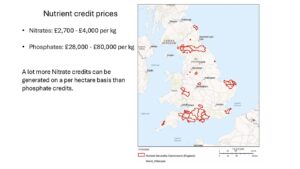
In terms of values, unlike the Government funding discussed earlier, nutrient credits have no fixed value as they are currently purchased by developers from the open market. And, because credits can only be traded within the catchment they were created in, there are effectively multiple small markets, each with their own quirks and individualities. Take for example in the Tees and the Solent catchments. In these, NE have their own nitrate mitigation projects and sell the credits at a fixed rate – setting an upper limit on the market. In other catchments the phosphate side of things is largely dictated by companies who can currently undercut the market by upgrading septic tanks to create credits.
With all this variation the range of credit prices can vary significantly. However, to give a general steer: Nitrate credits are generally in the region of £2,700 – 4,000 / credit, and phosphates anywhere from the upper 20 thousands up to £80,000 per credit.
It is also worth noting briefly that nutrient credits and BNG units can generated on the same area – which is known as stacking and can obviously increase the natural capital value of your land substantially on a per hectare basis.
2. Important NN considerations
The above may sound appealing to many of you, but as with any form of Natural Capital, there are important considerations.
- One of the main points from which many of these considerations stem is your location. You can only produce nutrient credits if you are within one of the 27 catchments designated by NE and typically credits can ONLY be allocated to a development within that same catchment. A credit generated in the Eden Valley cannot be allocated to a development within the Stodmarsh catchment.
- Secondly, to generate credits you will need to enter a legal agreement with your LPA which commits the landowner to the change in management practices or environmental works for at least 80 – 90 years. In practice NE will likely want the changes made to be in perpetuity.
- Lastly, the NN framework is an active part of planning policy and as such has the potential to change significantly within the length of your agreement. The best example of this are the changes soon to be enacted as part of the Planning and Infrastructure Act, granted royal assent in December. This act replaces bespoke mitigation measures currently expected from developers with the ‘Nature Restoration Fund’ (NRF). Which is effectively a giant kitty managed by NE that developers pay into to discharge planning conditions such as NN. NE will then use this money to carry out environmental and ecological works on a larger and more connected landscape scale in areas known as Environmental Deliver Plans (EDPs).
The current open market NN system will continue to operate alongside the NRF. In NN zones that are not covered by EDPs, private nutrient mitigation schemes will remain especially important.
3. Carbon Credits
The other major Natural Capital route that is a current option for landowners, is to generate carbon credits through either woodland creation or peatland restoration. I will focus on woodland creation, being the more accessible of the two options. Although with exception to the actual works that need to be undertaken, these two schemes work on a basis which is, on the whole, the same. I am not going to discuss the currently unregulated soil carbon market.
The woodland carbon code was fully launched by the forestry commission in 2011. It set up a system by which if a woodland was created and managed in line with the rules and guidelines of the code, it would generate carbon credits which can be sold on an open market to companies looking to offset their carbon footprint.
Since the Woodland Carbon code’s creation in 2011, all the way through to today, the carbon market has been a voluntary market, meaning credits purchased do not have any statutory power in terms of meeting mandatory emission targets. Arguably this has held the market back, although it still sees a consistent level of activity.
Before giving a quick summary of the market , it is necessary to briefly go over how a project is set up.
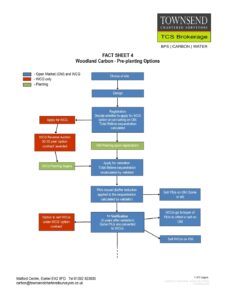
Firstly, you must register your project with the WCC. This requires maps, management plans, grant applications etc. You then begin planting.
Within three years of registration you must then validate your project to make sure it is on the right track. At this point you will be issued with a number of Pending Issuance Units equivalent to the total amount of carbon your project is predicted to sequester. From here on in I will refer to these as PIUs.
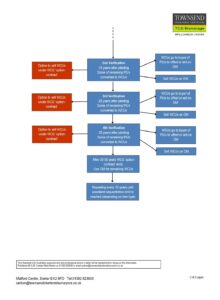
These are effectively a promise to sequester carbon over the course of your project. 5 years after registration your project will be verified, your project will continue to be verified every 10 years from this point.
With every verification a number of PIUs will be converted to Woodland Carbon Credits (WCUs), which represent actual carbon sequestered, rather than a promise.
These steps are displayed on our Fact Sheet 14 below:
4. Carbon credit sales
Both PIUs and WCUs can be sold, however one would expect WCUs to be more valuable. I say expect here because 99% of transactions so far have been PIUs. As of today, there have been over 14 million PIUs validated on 845 projects, and between 2020 and 2024 around 1.3 million of these PIUs have been sold. Only 182 projects have been verified, and only 4000 units were sold as WCUs instead of as PIUs. Most project owners are likely holding on to their WCUs, expecting their value to increase over time as Government carbon targets kick in throughout the duration of these projects.
- 845 projects validated
- 14 million PIUs issued
- 3 million PIUs sold
- 182 projects verified
- 4000 WCUs sold
- 99% of transactions have been PIUs.
Even without legislative change, price may well increase naturally as it has for PIUs. The average sale price of a PIU in 2020 was £11 but had increased to nearly £27 in 2024.
Again, as with NN there are important considerations to be had before beginning a project – The main points are.
- Firstly – Woodland creation is obviously a permanent change to the land.
- Secondly a project must meet certain criteria. It must demonstrate that it would not be financially viable without income from the carbon credits – this is known as the financial viability test. The 2nd test (legal) is that woodland creation is not a requirement – such as a planning obligation. Together these are known as ‘Additionality’.
- Lastly – Sales are not guaranteed and, being a voluntary market, demand could change significantly based on politics and public opinion. Whilst the government previously ran the woodland carbon guarantee – by which they did promised to purchase carbon credits from landowners, albeit at a lower than market price – the previous round closed in 2024, and as far as I am aware there has been no indication of it continuing.
David Marrow would be pleased to hear from you if you have any queries or questions. 01392 823935 or email bng@townsendcharteredsurveyors.co.uk
Full Recording